One of the interesting and challenging aspects of writing an academic essay is extracting pertinent and valuable quotes from the research. They should be insights into my chosen subject matter and themes which illuminate or contend with the view which I'm attempting to convey. I feel like I've found some very valuable and worthwhile quotes which would be beneficial to share here.
'The essay is always concerned with something already formed, or at best, with something that has
been; it is part of its essence that it does not draw something new out of an empty vacuum, but only
gives a new order to such things as once lived. And because he only newly orders them, not forming
something new out of the formless, he is bound to them; he must always speak “the truth” about
them, find, that is the expression for their essence.'
(G. Lukacs, Soul and Form 1974)
I am intending to use this quote at the beginning of my essay. I feel it gives a good introduction to the importance of an essay film creator owning their subjectivity. The essay here is seen as a reflection or deepening of the subject matter it is preoccupied with.
“characteristics of the essay film include the blending of fact and fiction, the mixing of artand
documentary-film styles, the foregrounding of subjective points of view, a concentration on
public life, a tension between acoustic and visual discourses, and a dialogic encounter with
audiences.”
(Nora M. Alter and Timothy Corrigan, Essays on the Essay Film 2017)
“ability to carry on a continual dialogue with other works of literature and other authors.
It does not merely answer, correct, silence or extend a previous work, but informs
and is continually informed by the previous work”
(M. Bakhtin, The Dialogic Imagination 1981)
“conceptual, psychopolitical, and representational dance with wolves, the drawn-out
imperative of the film is then to answer the silence that follows the death of the dogs, to
unmask an aesthetics of violence...to make the present of current events a far more
conceptually complex and vexed place for the subject experiencing that present as a past.”
(Timothy Corrigan, The Essay Film: From Montaigne after Marker 2011)
“science affects us by its contents, art by its forms; science offers us facts and
relationships between facts, but art offers us souls and destinies”
(G. Lukacs, Soul and Form 1974)
“one of the key elements of the essay film is the direct address of the receiver,
and voiceover is the most simple and successful way of actualizing such address”
(Laura Rascaroli, The Essay Film: Problems, Definitions, Textual Commitments 2008)
“The essayist allows the answers to emerge somewhere else, precisely in the position
occupied by the embodied spectator. The meaning of the film is constructed via this
dialogue, in which the spectator has an important part to play; meanings are presented by the
speaking subject as a subjective, personal meditation, rather than as objective truth. It is this
subjective move, this speaking in the first person that mobilizes the subjectivity of the
spectator.”
(Laura Rascaroli, The Essay Film: Problems, Definitions, Textual Commitments 2008)
“Humanism is, indeed, implicit in the essay structure—the assumption of a certain
unity of the human experience, which allows two subjects to meet and communicate on the
basis of this shared experience. The two subject positions, the “I” and the “you,” determine
and shape one another.”
(Laura Rascaroli, The Essay Film: Problems, Definitions, Textual Commitments 2008)

Showing posts with label Animation Research and Practice. Show all posts
Showing posts with label Animation Research and Practice. Show all posts
Wednesday, 13 December 2017

Monday, 11 December 2017
Sunday, 10 December 2017
Main Film Title
Trying to create a title for the film that represented its themes and complexity was a challenge. My initial thoughts were quite obvious with titles like The Dance, but this seemed quite on the nose. Brainstorming it resulted in some more nuanced ideas; Untethered Tread, playing with becoming lost in a memory through the sound of a footstep, and tread/thread; Tread and Temper, again referencing tread/thread, following a thread, unravelling with the alliteration of temper to evoke the emotional challenge; Soft Floor/Bare Boards, softness/toughness, flow between the two. The title that I hit on as seeming most evocative and descriptive was Sound Holds the Distance Travelled. Referring to the power of sound as the catalyst for the Melancholic Wife's journey back into her memory and the temporal distance between her present and past self. The whole of this journey is held in the sound waves.


Alternative Opening Sequence
In trying to create an opening to the film I was conscious of wanting to represent the creative heritage from which the film has evolved. The themes and subject matter explored within the film began in a web-comic strip called Splitting Borders developed with my creative partner Sadhbh Lawlor. We made our own handmade books of these strips which brought a tactile element to the work. From there we moved to short stories, again making our own books from the work. The film now represents a deepening of the work and with this opening I wanted to make a nod to that lineage.
The opening consists of a montage of photographs displaying the physical artifacts of the previous work.


The opening consists of a montage of photographs displaying the physical artifacts of the previous work.


I've maintained the black and white aesthetic of the film in the opening to maintain a visual relationship between the two mediums of photographs and drawings.


For the transition into the main film the camera zooms into the notebook, representative of where the work begun, as written words on a page.
Friday, 8 December 2017
Opening Sequence Reference
Part of the inspiration for the new opening sequence which uses photographs of some of my previous work came from the opening titles of To Kill a Mockingbird. I felt that this opening sequence was very effective in giving a sense of the world in which the story would take place. It uses objects to represent each of the characters, their personalities, their age, their preoccupations in a meaningful way.


Thursday, 7 December 2017
Character Sketch
The design for the Melancholic Wife exists in the comic pages but her face has never been shown so a big challenge will be building on that existing aesthetic and deepening her personality.


Tuesday, 5 December 2017
Closing Sequence
For the closing sequence we felt it would be potent to use visuals that illustrated the 'unromantic walls of her real life' These include representations of the Melancholic Wife's furniture, bookshelves and many elements of her creative process.


Opening Sequence
For the opening sequence we have decided to try and use design imagery that already exists from the comic work.


Sadhbh had the idea of the camera following the line across a long pan which the character portraits emerge from and the titles sit above.

Monday, 4 December 2017
Melancholi Wife Animatic Version 14
Changes here include a modification to the narration of the final sequence. It is now spoken in the present tense rather than the past tense, this will hopefully add to the delineation between her teenage self and her adult self.
Sunday, 3 December 2017


Saturday, 2 December 2017
The Melancholic Wife Storyboards - Sixth Sequence


The Melancholic Wife re-emerges back into the real world, the 'unromantic walls of her real life'. She moves through the room, giving us an opportunity to see the world she inhabits, the objects that make up her life. She turns on a lamp, she has gained illumination and she reaches for her journal to record it, 'trying to hold on to the nuances of her transmutations'.


Thursday, 30 November 2017
Sound Design - Music Soundtrack
Just as with voice over it feels imperative to be conscious of the power of music to shape the mood and reaction of an audience to the film. In practical terms, this being a student film and therefore on a limited budget, the opportunity to freely select music is limited by economics as well. We feel fortunate in some regards because we found that the tone and flow of the visuals married well with the Classical Music genre. But it feels important to note that this wouldn't have been our first choice as in our minds the protagonist does inhabit a modern world with a modern taste in music, so compromise is necessary. The classical music genre has a longer history than most musical genres so there are more compositions that are license free with some performances coming under creative commons.
I used the website Musopen to explore options for the soundtrack. Musopen is a 501(c)(3) non-profit focused on increasing access to music by creating free resources and educational materials. They provide recordings, sheet music, and textbooks to the public for free, without copyright restrictions.
For the first drafts of the animatic, myself and Sadhbh chose Reverie by Debussy for the first act of the film before the Melancholic Wife chooses her own music. We felt this gave a good sense of the initial journey she embarks on. For the change moment we chose Wagner music, for the sense of drama and a journey, specifically from the opera Tannhauser. These two pieces acted as a starting point a placeholder to help visualise the film.
When it came time to consciously examine and choose the music, myself and Sadhbh decided to attempt to find female composers to try and rebalance the gender representation given the narrator is a male voice. Using Musopen again we discovered two compositions; for the main body of the film we selected a piece called Three Dramatic Etudes by Pandora Selfridge; for the change of tone we have picked a section from 4 Sketches, Op.15 by Amy Marcy Beach. We feel that the first composition is working well but that the second one may need further exploration as it may not represent enough of a positive tone shift.
Monday, 27 November 2017
Melancholic Wife Animatic Version 11
With this animatic I've added an opening and closing sequence to the film. The opening uses the cover illustration from the first zine collection of the short stories. The font is from the cover and website as well. The ending sequence uses pages and panels from the comic to give a sense of the wider world in which the Melancholic Wife exists.
Thursday, 23 November 2017
Sound Design - Voice Over
My short film employs a voice over narration to work with the visual storytelling. This narration is an adaptation of the text narration of the original comic. In collaborating with Sadhbh we have tried to be conscious of the power of having a voice describing the story of our protagonist. There is a distance that necessarily exists because she is not speaking directly to the audience of her experience. We further wanted to explore this distance by having a male voice speak the story. Our reasoning behind this is a desire to investigate and play with the conventional dominance of men telling women's stories. In societal terms the male voice can seem to lend an unconscious authority and we want to use this bias to support the telling of an unconventional story exploring the inner complexity of a woman's experience.
From the research into my extended essay on the Essay Film genre I have learned of the opinion that voice over can communicate as authoritarian in film. Dictating to the audience what they should think and how they should feel about the accompanying visuals. I also want to be conscious of this by pursuing a storytelling tone to the narration. There will hopefully be a neutrality to it, a separateness which leaves room for the visuals to occupy its own space and leaves a space in-between for the subjective reaction of an audience to reside in.
Tuesday, 21 November 2017
The Melancholic Wife Storyboards - Fifth Sequence


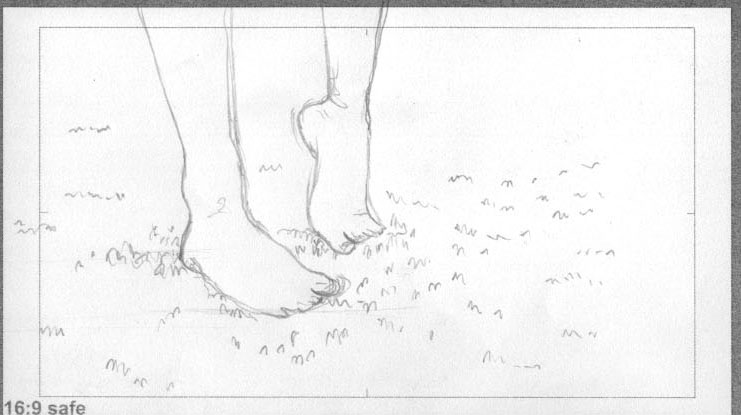


The lights come on and the Melancholic Wife must pick herself up off the floor and contend with the darkness of her melancholy again. She has managed to bring one of the ghosts of her former self along with her into this new arena of contention, the ghost floats free, still dancing. The Melancholic Wife draws the spotlight into her, assimilating its energy inside herself. She uses this energy to access her creative self expression, beginning to dance, move and project the light into the darkness, taking ownership for the moment of the space. The light, the white transcends the black, the Melancholic Wife and the ghost disappear in the brilliance as they join together. She pauses for a moment, honouring the coming together, she can bring the lesson which the ghost had to teach her with her back into the unromantic walls of her real life through the door which appears from the last vestiges of light.
Subscribe to:
Posts (Atom)